Updated
In short
Microchipping is a legal requirement for all dogs in the UK by eight weeks old, and for cats in England by twenty weeks, including indoor cats. The chip itself is quick to fit and about the size of a grain of rice. The part that actually reunites you with a lost pet is not the chip, though. It is the registration behind it, and only if your details on it are up to date. A chip registered to an old address or a dead phone number will not get them home.
Authored by
 Natalie Brundish
Editor, HowPets
Reviewed by
 Dr Jen Hipwell
Head of Veterinary Services
Table of contents
Most puppies and kittens arrive already chipped, because the breeder should have arranged it. That makes the job in front of most new owners a small one. Get it scanned, and get the details changed into your name.
Is microchipping a legal requirement in the UK?
Dogs: yes, everywhere in the UK. Every dog must be microchipped and registered by the time they are eight weeks old.
Cats: yes in England, by twenty weeks. This includes cats that never go outside. Scotland, Wales and Northern Ireland do not currently require it, though it is still worth doing.
The fine is up to £500, and the same penalty applies for failing to register the chip on an approved database. A chip that is not registered does not satisfy the law and does not help you get your pet back.
The breeder should have arranged it before your puppy or kitten comes home. If they have not, the responsibility becomes yours once the animal is.
At what age can you microchip a puppy or kitten?
Puppies: usually six to eight weeks, and often done by the breeder before you collect them. If it's not been done, a vet will normally do it at the first vaccination appointment at around eight weeks.
Kittens: often a little later. Cats are sometimes chipped at neutering rather than earlier. The needle is larger than a vaccination needle, and a fair number of animals react to it. Doing it while a cat is already under anaesthetic is kinder, and it is a common approach.
Older animals can be chipped at any time. There is no upper age limit, and a rescue animal of any age can be microchipped.

Get our latest guides, stories and offers by email
How microchipping works
The procedure is essentially an injection, with a needle noticeably larger than the one used for a vaccine.
The chip itself is tiny. About the size of a grain of rice, containing a small circuit board, and injected under the skin between the shoulder blades.
It is quick, but it does sting. It makes them jump, and they may well tell you how little they enjoyed it. A biscuit and a bit of a fuss afterwards usually settles it, and it is over in seconds.
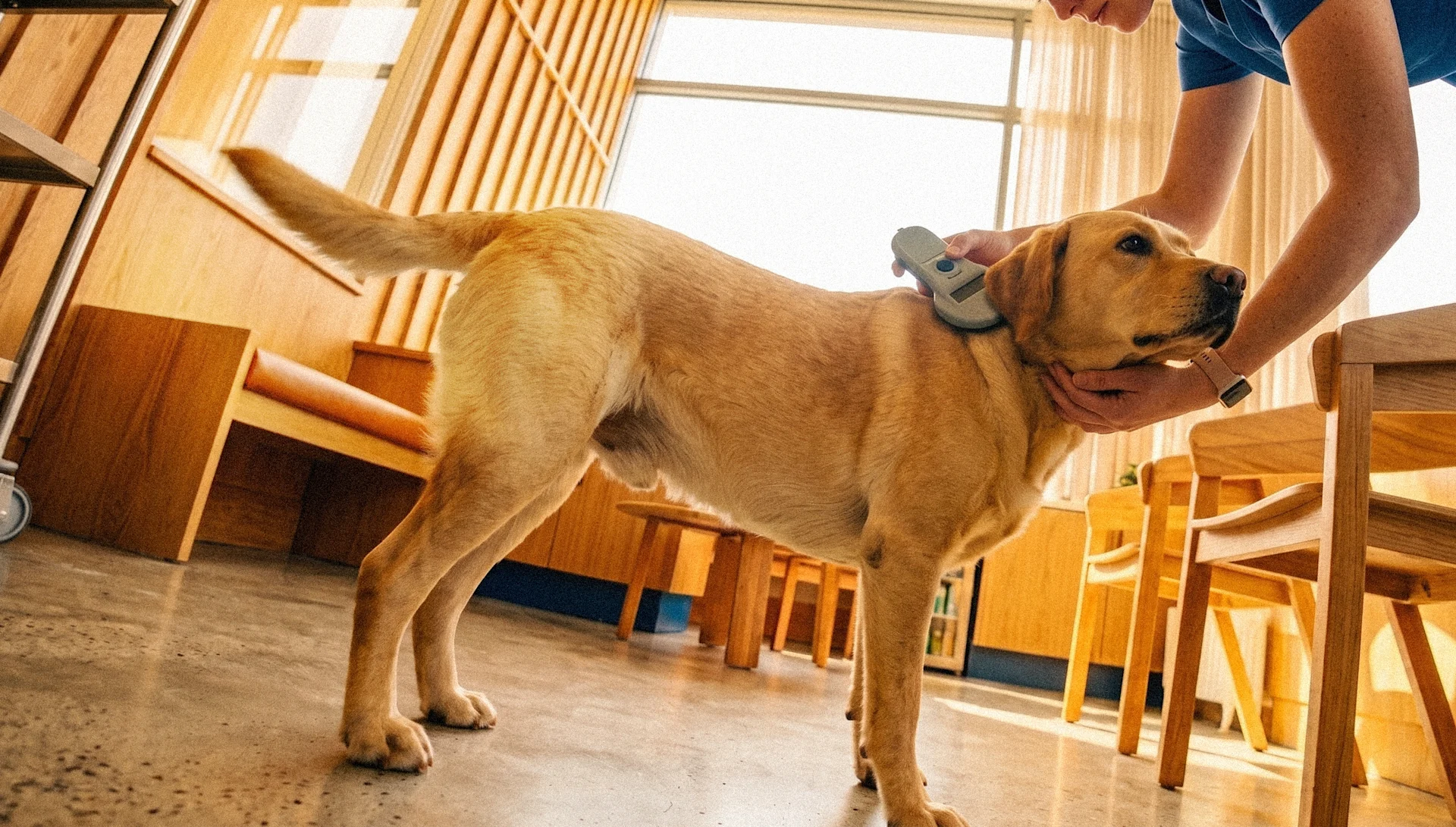
Every chip carries a unique number. When a lost animal is scanned, that number is looked up on a central database and connects them back to you. Every vet practice has a scanner, as do most rescue centres and dog wardens.
Some chips now read body temperature as well, which spares an animal a thermometer. Your practice needs the right kind of scanner to read it, so it is worth asking whether yours does.
A microchip is not a tracker. It has no GPS and no battery, and it cannot tell you where your pet is. It only works when somebody finds your animal and scans them. A GPS collar tag is a different product that does track in real time, and the two are complementary rather than alternatives.
“It is absolutely critical that those registration details are kept with that pet's microchip record.”
Dr Jen Hipwell / Head of Veterinary Services
Registering and keeping your details up to date
A microchip only works if the number on it leads back to you. That means your name, address, phone number and email sitting on an approved database, and being right on the day your pet goes missing. It is the step owners most often skip.
Check the chip is registered to you, not the breeder. Most breeders register the litter in their own name, so the transfer is yours to complete. Changing it over to you is the single most important thing to do in your first week.
Get it scanned at your first vet appointment. Two things are being confirmed. The chip is actually there and working, and the number on it matches the paperwork you were given. Occasionally a chip has migrated or fails to read. Far better to find that out at a routine appointment than on the day your pet goes missing.
Keep the details current for the animal's whole life. Move house, change your mobile number, change email address, and the record needs updating each time. There are several approved databases, and it is worth choosing one that makes updating quick. A database you find painful to use is one you will not bother with in three years' time, which is when it matters. Pet Database, our own Defra-compliant registry, lets you update your details in a couple of minutes, free, for the life of your pet.
Register your pet's microchip with Pet Database. Keeping that record secure and lawful is their job, and it is what gives you the best chance of getting your pet back if they ever go missing.
What microchipping costs
Microchipping on its own is one of the cheaper things a vet does, and in most cases you will not pay for it separately at all, because the breeder has already covered it.
Where you will see it is bundled. Practices often fold microchipping into a puppy or kitten package, alongside vaccinations, flea and worm treatment and sometimes neutering. Those bundles usually work out cheaper than paying for each item.
Ask your practice for its price list. Practices publish their prices, so you can compare before you register.
Updating your details should be free or close to it on any reputable database. If you are being asked for a significant fee simply to change an address, check what the database actually offers.
Key takeaways
All dogs in the UK must be microchipped and registered by eight weeks old.
Cats in England must be microchipped by twenty weeks, indoor cats included. It is not yet required in Scotland, Wales or Northern Ireland.
The fine is up to £500, and the same applies for not registering the chip.
Puppies are usually chipped at six to eight weeks, kittens sometimes later, often at neutering.
The chip is the size of a grain of rice and goes under the skin between the shoulder blades. It stings briefly.
A microchip is not a GPS tracker. It only works when someone scans your pet.
Get the chip scanned at your first vet visit and change the registration into your name.
Update your details every time you move or change your phone number. An unregistered chip is no use to anyone.
Frequently asked questions
At what age can you microchip a puppy? Usually six to eight weeks, and the breeder should have arranged it. If not, a vet will normally do it at the first vaccination appointment.
Is microchipping a legal requirement for cats? In England, yes, by twenty weeks old, including indoor cats. It is not currently required in Scotland, Wales or Northern Ireland.
Does microchipping hurt? It stings briefly. The needle is larger than a vaccination needle, so most animals jump and some object loudly. It is over in seconds, and a treat afterwards usually settles it.
Can a microchip track my lost pet? No. A microchip has no GPS and no battery. It stores a number that identifies your pet when somebody scans them. A GPS collar tag is a separate product if you want live tracking.
My puppy is already chipped. Is there anything I need to do? Yes, and it is important. Check the registration is in your name rather than the breeder's, and update it if not. Have the chip scanned at your first vet appointment to confirm it works.
What happens if I move house? Update your microchip record with your new address and phone number. A chip registered to an old address will not get your pet home.
How much does microchipping cost? Often nothing extra, as the breeder should have paid for it. Where you do pay, it is usually bundled into a puppy or kitten package with vaccinations and parasite treatment.
For more on keeping your pet safe, browse our Safety & protection guides. Microchipping is one step in the first year, covered in our guides to looking after a puppy and a kitten.
Sources: The microchipping law, including the eight-week deadline for dogs, the twenty-week deadline for cats in England and the £500 fine, was verified against gov.uk on 6 October 2026.
Microchip registration
More on microchippingNatalie Brundish
Editor, HowPets