Updated
In short
Puppy crate training works when the crate becomes the best place in the world for your puppy. It fails when it becomes a place they are simply put. Get the conditioning right and you accelerate toilet training, protect your puppy's sleep, and give them somewhere to switch off. Get it wrong and you have built a box your dog does not want to enter.
Authored by
 Steve Mann
Dog Trainer & Behaviourist
Table of contents
I have spent my career working with puppy owners, and crate training is where I see the most avoidable damage done. Almost none of it comes from bad intentions. It comes from the crate being used before it has been introduced.
Here is how I would do it.
Why crate training works
If it's conditioned properly, it's the best place in the world for a dog. If it's not conditioned properly, it's the worst place for a dog. That is the whole thing, really. We have an opportunity, and it can go either way depending on what we do with it.
Done properly, the crate becomes a place your dog can switch off and fully relax. That matters enormously for a puppy. There is a lot of physical development going on, a lot of exposure to the world, and they need to sleep and process it. If they are not getting quality sleep it will affect their behaviour and their health, exactly as it would for you or me.
Puppies need somewhere near sixteen hours of sleep a day. If it is the summer holidays, the kids are home and the house is frantic from morning until night, your puppy is not getting anywhere near that. Not unless they have a safe space to retreat to.
So no, it isn't cruel. It can be cruel if you don't do it properly, or it can be brilliant if you do. Let's do it properly.
Choosing the right crate size
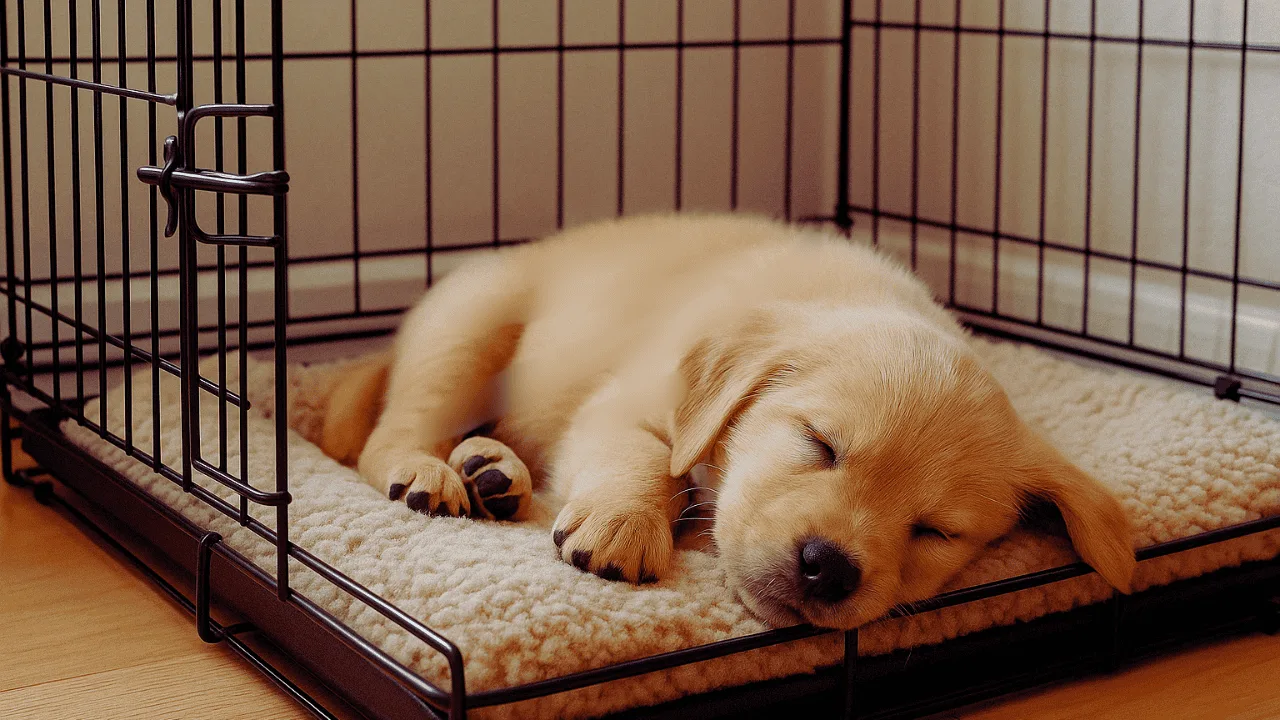
Too small is a big no-no. It causes physical stress, the dog cannot move properly, and there are welfare issues on top of the feeling of being trapped. Your puppy needs to be able to comfortably stand up, turn around and lie down in there. They should also be able to eat and drink without being physically compromised.
Know the height and size of your pup now. Then know the height and size they will be in four to eight weeks, because they grow very, very quickly.
Too big brings its own problems. The element of safety can be lost. You can end up with an area big enough that the dog feels they need to guard it. You also get a puppy who is very comfortable sleeping and eating in one corner, and weeing and pooing in the other. That compromises the toilet training entirely.
There is a Goldilocks size you are looking for. If you have ended up with a crate that is too big for now, don't replace it. Put some sort of partition in there, a bit of plywood if need be. Just make sure ventilation and lighting are still sufficient.

Get our latest guides, stories and offers by email
Introducing the crate positively
Have the crate with the door open, inside a den. We are all much more comfortable going forwards if we know we can back away. A puppy is more comfortable going into a crate if they know they can back out of it. Keeping that containment in the den, with the crate as the most comfortable spot where all the good stuff appears, is very healthy.
It gives the pup more choice about where they are, which is really important.
Take advantage of every opportunity to build a positive association with being in the crate. Meals, chews, treats, stuffed food, toys, all of those should arrive in the crate.
What I like doing, and what I write about in one of my books, is having a den wizard.
“I like to have treats in the den and then allow the pup to discover them. Not put the pup in and then follow it with the good thing.”
Steve Mann / Dog Trainer & Behaviourist
That distinction matters more than almost anything else here. The good stuff is already in there. The pup discovers it, finds the treats, comes back out again. That's fine, no problem. Then I put treats in again, maybe keep the pup out for a little while, and let them discover them, like the tooth fairy.
You are not luring your puppy into a box. You are making a box worth investigating.
A step-by-step crate training schedule
Scheduling has to be dictated by your lifestyle and your family's lifestyle, so I am wary of handing anyone a rigid timetable. But there are moments in every day that are made for it.
Every mealtime. Feed in the crate, every time.
Every chew. A chew in the den is among the most useful habits you can build.
After anything exciting. Coming in from a walk, after play, after visitors, straight into the crate with something good.
Every nap. Even if they have fallen asleep in the living room, I would pick them up and put them in the den. Then when they come round a bit woozy and feeling chilled, they are already in there.
Every night. When they want to feel safe and secure and bonded and relaxed, that is in the den.
The one thing to hold onto is balance. With a clear conscience, they are in the den because you know it is the best place for them. That is only true if the rest of their day has enough outlets, exposure and company in it. The den is not a substitute for a life.
Crate training at night
Introduce it with all the good stuff and use it as a decompression tank, and the pup will be grateful for it.
Use it several times throughout the day, not just overnight. Use it while you are pottering about and the pup can see you coming and going, or while you are running the hoover round. What we do not want is the crate only ever predicting that you are about to disappear.
Never use it as a punishment or a time-out. That will poison all the good investment you have made.
Use it upstairs as well as downstairs, particularly for the first few nights, to help the pup feel safe.
How long should a puppy be in a crate?
With a puppy you have to think about toilet training first, so I would be maxing out at about an hour to ninety minutes initially. Always know why the dog is in there. It should never just be to make your life easier. There should be a positive purpose behind it.
As the dog gets older and people are going out to work, we want them safe and comfortable on the ground floor, or in the kitchen, or with the run of a room or two. Generally an older dog is only crated if there is an issue with chewing or similar. That is not a crate training problem. That is a chewing or stress problem, and there is a bigger picture to address.
If an older dog does have to be crated, I would cap it at about three hours. I would not want that to be common.
Six or seven hours a day in a crate is no life. That is unhealthy, and it is not why we have a dog. If that is going to happen, get a dog walker in. Better still, ask whether the dog has to be crated at all. A child gate across the kitchen door gives them the run of the room, so they can find cool spots, warm spots and comfortable spots. If there is a reason the dog must be crated that long, let's address the reason rather than treat it as the solution.
Key takeaways
A crate is either the best place in the world for your dog or the worst, and which one is decided entirely by how you introduce it.
Size it so your puppy can stand, turn around, lie down, eat and drink comfortably, and allow for four to eight weeks of growth.
Too big is a real problem rather than a kindness, because it lets a puppy sleep in one corner and toilet in the other.
Put the good stuff in first and let your puppy discover it. Never put the puppy in and then reward them.
Puppies need around sixteen hours of sleep a day, and a den is often the only way they get it.
Cap crate time at about an hour to ninety minutes for a puppy, and around three hours for an adult dog.
Never use the crate as punishment or a time-out.
Frequently asked questions
Is crate training cruel? Not when it's done properly, because the crate is never used as punishment and the puppy is never forced in. It becomes cruel if it is misused as a time-out, or the dog is left in there for excessive periods.
What if my puppy point-blank refuses to go in? Meet the dog where they are. You may need to take the crate apart and start with just two sides of it, so it is barely a crate at all. Build from there. Nobody has to do anything they don't want to do, and there is always an alternative.
Can an older rescue dog still be crate trained? Absolutely, with all the same principles. It may take longer if the dog has had a bad experience with crates before, because then you are counter-conditioning rather than purely positively conditioning from a neutral start point. A dog picked up off the streets with a grab stick and moved from van to crate to crate has had crates poisoned for them. The principles are identical, the timeline is longer.
Do I need a crate at all? No. Child gates are perfect, and a playpen area will normally do the same job, including helping with toilet training. As soon as a dog trainer says you should always or you should never, be suspicious. We are all variable, and so are our dogs.
Should I use the same crate upstairs and downstairs? Two is fine if the layout demands it. The same crate is better, because you are not conditioning two different things, and it carries the same smells and the same comfort blanket. If your pup feels good about it, use it in the car too. That pays off at the vet's, when a dog coming round from surgery finds themselves behind a closed door for the first time.
Get the crate and the den set up before your puppy arrives, and start the den wizard on day one rather than the first night.
If you are working through the first few weeks, read our guides to the first night with a puppy and puppy toilet training. Both lean heavily on the crate being conditioned properly first.
You will find more in our Behaviour & training guides, and the whole first year in our complete guide to looking after a puppy.
Steve Mann
Dog Trainer & Behaviourist
Steve Mann has been a dog trainer since 1987 and is the founder of the Institute of Modern Dog Trainers. He is the author of Easy Peasy Puppy Squeezy, the UK's best-selling dog training book, and presents the BBC Maestro course Dog Training with Steve Mann.